Head Start Pathway / Amalgamation

Share Head Start Pathway / Amalgamation on Facebook Share Head Start Pathway / Amalgamation on Twitter Share Head Start Pathway / Amalgamation on Linkedin Email Head Start Pathway / Amalgamation link

How should local government work in the future?

Head Start and Backstop pathways

Central Government has announced significant changes to how local government will be structured across New Zealand.

A key part of this reform is moving away from the current two-tier system of district and regional councils.

Regional councils, in their current form, are expected to be replaced, with their functions – such as environmental management, transport planning and water management – absorbed into new, larger council structures (expected to be across whole or sub-regions).

The Government is encouraging councils to form unitary authorities, meaning district/city and regional functions are combined into a single council.

To support this, it has created the Head Start pathway, which allows councils to work together and propose their own reorganisation. Councils have a short window in 2026 to develop and submit proposals, with agreed changes likely to take effect from the 2028 local government elections.

Head Start is voluntary and gives councils the chance to shape their own future, move earlier, and design solutions that suit their region.

If councils don’t put forward a proposal, the Government has said it will decide for them through a compulsory “Backstop” process after 2028.

Councils who choose the Backstop option risk less local control over what the new council structure looks like, and an interim governance body may run the transition.

Importantly, there’s no guarantee the community will be able to shape the direction of their future structure and representation under either pathway.

What we think so far

This is a significant change. As we work through this, a few things are clear.

We want to:

  • Keep decision-making as close to our communities as possible
  • Protect the identity and direction setting ability of our district
  • Make sure our ratepayers and assets are treated fairly
  • Continue delivering the essential services people rely on every day.

Whichever option is chosen, Waimakariri will no longer exist or operate as a standalone district in the way it does today.

This means:

  • Residents need to think about and make decisions for the betterment of a wider area or sub-region
  • Resources, funding and infrastructure investment would be shared across that area
  • Local communities would need to be confident they still have a strong voice and fair outcomes.

Our position right now

We haven’t made any decisions.

We are:

  • Open to talking with our neighbouring councils
  • Taking the time to understand the options
  • Committed to hearing from our community before taking a formal position.

What we do know is that Waimakariri residents are well-informed and expect to have a say. We’ve seen that clearly in previous reforms – especially Three Waters.

We encourage you to:

  • Read the information and take time to think about what options you prefer
  • Talk it through with your family and community
  • Share your views with us—either through the survey below or via email
  • Ask any questions on our online portal. We will do our best to answer these

To do this complete the survey below.

The options we’re considering

At this stage, there are three main directions being discussed.

All assume regional Council functions and responsibilities—such as environmental management, transport planning and water management—are absorbed. Below are several assumptions that we anticipate under various models.

(A) Waimakariri as a Unitary Council

(B) A North Canterbury Unitary Council

(C) A Greater Christchurch Unitary Council

See the options in detail below.

Feedback closes 5 July 2026.

How should local government work in the future?

Head Start and Backstop pathways

Central Government has announced significant changes to how local government will be structured across New Zealand.

A key part of this reform is moving away from the current two-tier system of district and regional councils.

Regional councils, in their current form, are expected to be replaced, with their functions – such as environmental management, transport planning and water management – absorbed into new, larger council structures (expected to be across whole or sub-regions).

The Government is encouraging councils to form unitary authorities, meaning district/city and regional functions are combined into a single council.

To support this, it has created the Head Start pathway, which allows councils to work together and propose their own reorganisation. Councils have a short window in 2026 to develop and submit proposals, with agreed changes likely to take effect from the 2028 local government elections.

Head Start is voluntary and gives councils the chance to shape their own future, move earlier, and design solutions that suit their region.

If councils don’t put forward a proposal, the Government has said it will decide for them through a compulsory “Backstop” process after 2028.

Councils who choose the Backstop option risk less local control over what the new council structure looks like, and an interim governance body may run the transition.

Importantly, there’s no guarantee the community will be able to shape the direction of their future structure and representation under either pathway.

What we think so far

This is a significant change. As we work through this, a few things are clear.

We want to:

  • Keep decision-making as close to our communities as possible
  • Protect the identity and direction setting ability of our district
  • Make sure our ratepayers and assets are treated fairly
  • Continue delivering the essential services people rely on every day.

Whichever option is chosen, Waimakariri will no longer exist or operate as a standalone district in the way it does today.

This means:

  • Residents need to think about and make decisions for the betterment of a wider area or sub-region
  • Resources, funding and infrastructure investment would be shared across that area
  • Local communities would need to be confident they still have a strong voice and fair outcomes.

Our position right now

We haven’t made any decisions.

We are:

  • Open to talking with our neighbouring councils
  • Taking the time to understand the options
  • Committed to hearing from our community before taking a formal position.

What we do know is that Waimakariri residents are well-informed and expect to have a say. We’ve seen that clearly in previous reforms – especially Three Waters.

We encourage you to:

  • Read the information and take time to think about what options you prefer
  • Talk it through with your family and community
  • Share your views with us—either through the survey below or via email
  • Ask any questions on our online portal. We will do our best to answer these

To do this complete the survey below.

The options we’re considering

At this stage, there are three main directions being discussed.

All assume regional Council functions and responsibilities—such as environmental management, transport planning and water management—are absorbed. Below are several assumptions that we anticipate under various models.

(A) Waimakariri as a Unitary Council

(B) A North Canterbury Unitary Council

(C) A Greater Christchurch Unitary Council

See the options in detail below.

Feedback closes 5 July 2026.

  • Letter to Residents

    Share Letter to Residents on Facebook Share Letter to Residents on Twitter Share Letter to Residents on Linkedin Email Letter to Residents link

    Kia ora Waimakariri

    The Government has announced significant changes to how local government will be structured across New Zealand. To be clear Council is not driving this reform – it is being driven by the Government. We have been given three months to provide our preference which isn’t a lot of time. Council believes it is vital to hear ourcommunities views before coming to a position.

    A key part of this reform is the move away from the current two-tier system of district and regional councils.

    Regional councils, in their current form, are expected to be replaced, with their functions and responsibilities –such as environmental management, transport planning and water management – absorbed into new, larger council structures.

    The Government is explicitly encouraging councils to form unitary authorities, bringing district and regional functions together into a single council, with proposals due in August and changes likely to take effect from the 2028 local elections.

    Councils have been given a very short window to work with neighbouring councils to develop proposals for how councils might be reorganised (called Head Start). If councils don’t put forward a proposal, the government has said it will decide for them (called Backstop).

    The purpose of this engagement is to hear your views

    While early participation may offer a clearer pathway, the ‘back-stop’ pathway is unclear. Before forming a position, we consider it critical to understand the view of the community.

    We are one of the largest councils in the South Island by population, with a community that has grown steadily for 30 years and is projected to reach 100,000 residents by 2050.

    We are proud of our strong financial track record. We hold an AA rating with a Stable Outlook from Fitch and are the only council to receive two AA grades from CouncilMARK – a local govt excellence programme.

    Waimakariri is widely regarded as one of the most effective councils in the country and we have built strong relationships across Canterbury.

    What this could mean for Waimakariri

    This exercise requires thinking outside of our boundaries.

    We need to consider alternative structures and operating arrangements that provide the essential council services going forward, as well as functions previously undertaken by regional councils.

    We will take the time to understand what options are in front of us and will work with neighbouring councils where it makes sense to do so.

    It should be noted that we do already work effectively through the structure of the Greater Christchurch Partnership (comprising Christchurch, Selwyn, Environment Canterbury, mana whenua and other partners) and the Canterbury Mayoral Forum (representing all Councils from Waitaki to Kaikōura.)
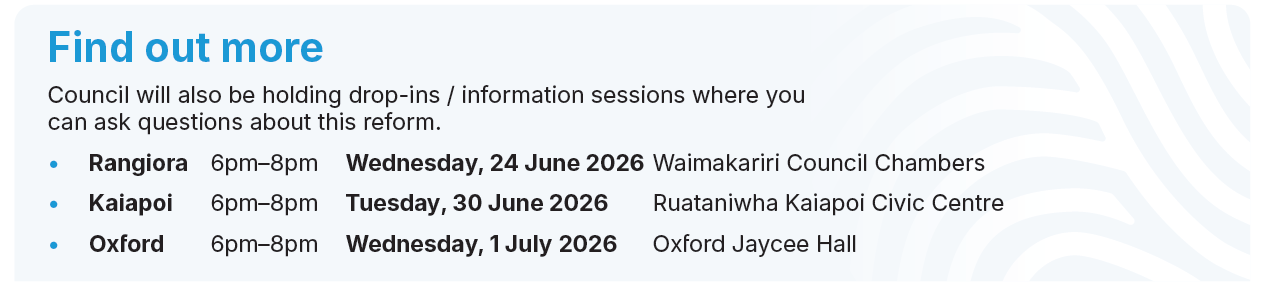
    What happens next

    Please take the time to read through the engagement material and provide your views.

    We’ll keep working through the options with neighbouring councils.

    Your feedback will help inform our next steps. However, any proposal needs to be accepted by the Government.

    If our options are declined by central Government, the Council will go into the ‘Backstop’ option.

    The Backstop is the Government’s fallback option if councils don’t agree on a proposal. This means reform will still go ahead after 2028 but with less local control over the outcome.

    We will make sure to keep the community well informed and updated with any formal position/ submission on reform.

    We look forward to hearing from you.

    Yours sincerely,
    Kia ora Waimakariri

    The Government has announced significant changes to how local government will be structured across New Zealand. To be clear Council is not driving this reform – it is being driven by the Government. We have been given three months to provide our preference which isn’t a lot of time. Council believes it is vital to hear ourcommunities views before coming to a position.

    A key part of this reform is the move away from the current two-tier system of district and regional councils.

    Regional councils, in their current form, are expected to be replaced, with their functions and responsibilities –such as environmental management, transport planning and water management – absorbed into new, larger council structures.

    The Government is explicitly encouraging councils to form unitary authorities, bringing district and regional functions together into a single council, with proposals due in August and changes likely to take effect from the 2028 local elections.

    Councils have been given a very short window to work with neighbouring councils to develop proposals for how councils might be reorganised (called Head Start). If councils don’t put forward a proposal, the government has said it will decide for them (called Backstop).

    The purpose of this engagement is to hear your views

    While early participation may offer a clearer pathway, the ‘back-stop’ pathway is unclear. Before forming a position, we consider it critical to understand the view of the community.

    We are one of the largest councils in the South Island by population, with a community that has grown steadily for 30 years and is projected to reach 100,000 residents by 2050.

    We are proud of our strong financial track record. We hold an AA rating with a Stable Outlook from Fitch and are the only council to receive two AA grades from CouncilMARK – a local govt excellence programme.

    Waimakariri is widely regarded as one of the most effective councils in the country and we have built strong relationships across Canterbury.

    What this could mean for Waimakariri

    This exercise requires thinking outside of our boundaries.

    We need to consider alternative structures and operating arrangements that provide the essential council services going forward, as well as functions previously undertaken by regional councils.

    We will take the time to understand what options are in front of us and will work with neighbouring councils where it makes sense to do so.

    It should be noted that we do already work effectively through the structure of the Greater Christchurch Partnership (comprising Christchurch, Selwyn, Environment Canterbury, mana whenua and other partners) and the Canterbury Mayoral Forum (representing all Councils from Waitaki to Kaikōura.)

    What happens next

    Please take the time to read through the engagement material and provide your views.

    We’ll keep working through the options with neighbouring councils.

    Your feedback will help inform our next steps. However, any proposal needs to be accepted by the Government.

    If our options are declined by central Government, the Council will go into the ‘Backstop’ option.

    The Backstop is the Government’s fallback option if councils don’t agree on a proposal. This means reform will still go ahead after 2028 but with less local control over the outcome.

    We will make sure to keep the community well informed and updated with any formal position/ submission on reform.

    We look forward to hearing from you.

    Yours sincerely,

  • (A) Waimakariri as a Unitary Council

    Share (A) Waimakariri as a Unitary Council on Facebook Share (A) Waimakariri as a Unitary Council on Twitter Share (A) Waimakariri as a Unitary Council on Linkedin Email (A) Waimakariri as a Unitary Council link

    supporting image


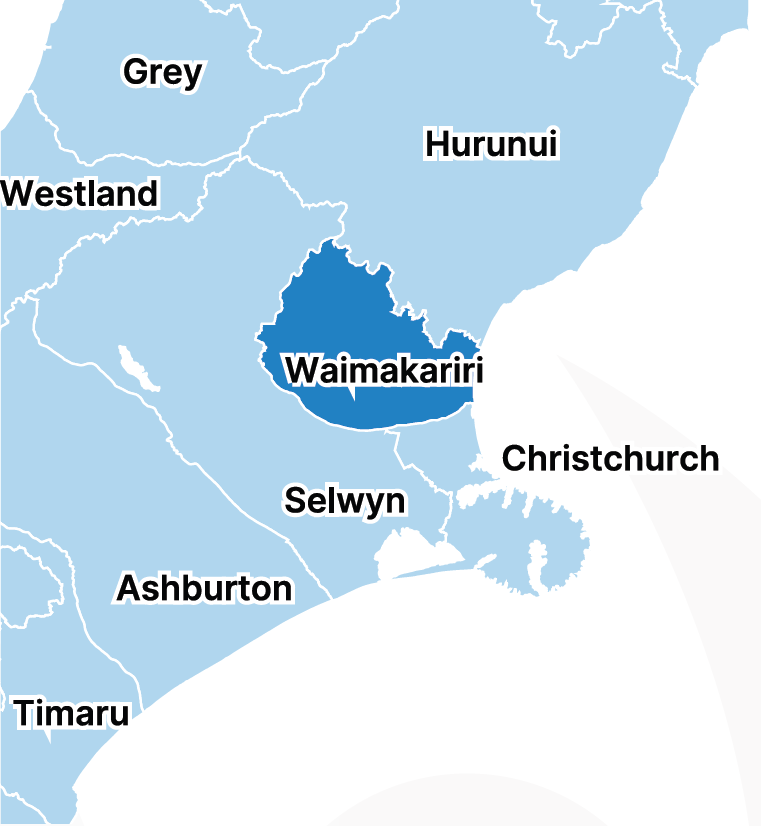
    While this does not currently appear to be an option under the Head Start proposal. Support for this option may leave the Council open/subject to the Government’s Backstop option where a future structure could be imposed without local say. We are aware other councils are considering this as an option for them.

    However, under such an option Waimakariri would become a standalone unitary council, taking on both district and regional council responsibilities without merging with neighbouring districts.

    What works in its favour

    • Maintains local representation

    Decision-making would remain entirely focused on Waimakariri. This maintains local advocacy in decision-making.


    While this does not currently appear to be an option under the Head Start proposal. Support for this option may leave the Council open/subject to the Government’s Backstop option where a future structure could be imposed without local say. We are aware other councils are considering this as an option for them.

    However, under such an option Waimakariri would become a standalone unitary council, taking on both district and regional council responsibilities without merging with neighbouring districts.

    What works in its favour

    • Maintains local representation

    Decision-making would remain entirely focused on Waimakariri. This maintains local advocacy in decision-making.

    • Protects district identity

    Waimakariri would continue as a standalone district with its existing character, governance structures and community focus.

    • Clear accountability

    Residents would continue to deal with one council that is directly responsible to them, with no competing regional priorities.

    • Opportunity to tailor partnerships and shared services

    A standalone unitary could continue to partner with neighbouring councils and central agencies (such as NZTA and national regulators) to deliver services like transport provision and scientific monitoring, while retaining flexibility to choose how and where services are shared.

    • Builds on strong performance

    Waimakariri has a well-established reputation for prudent financial management, asset stewardship and service delivery, which could continue under a unitary model.

    Challenges and risks

    • Scale and capacity

    Taking on regional responsibilities alone may place additional pressure on resources, staffing and expertise.

    • Higher costs for ratepayers

    Without sharing services or costs with neighbouring districts, delivering regional functions could be more expensive.

    • Missed efficiencies

    There may be fewer opportunities to reduce duplication or achieve economies of scale compared to a combined model.

  • (B) A North Canterbury Unitary Council

    Share (B) A North Canterbury Unitary Council on Facebook Share (B) A North Canterbury Unitary Council on Twitter Share (B) A North Canterbury Unitary Council on Linkedin Email (B) A North Canterbury Unitary Council link

    supporting image


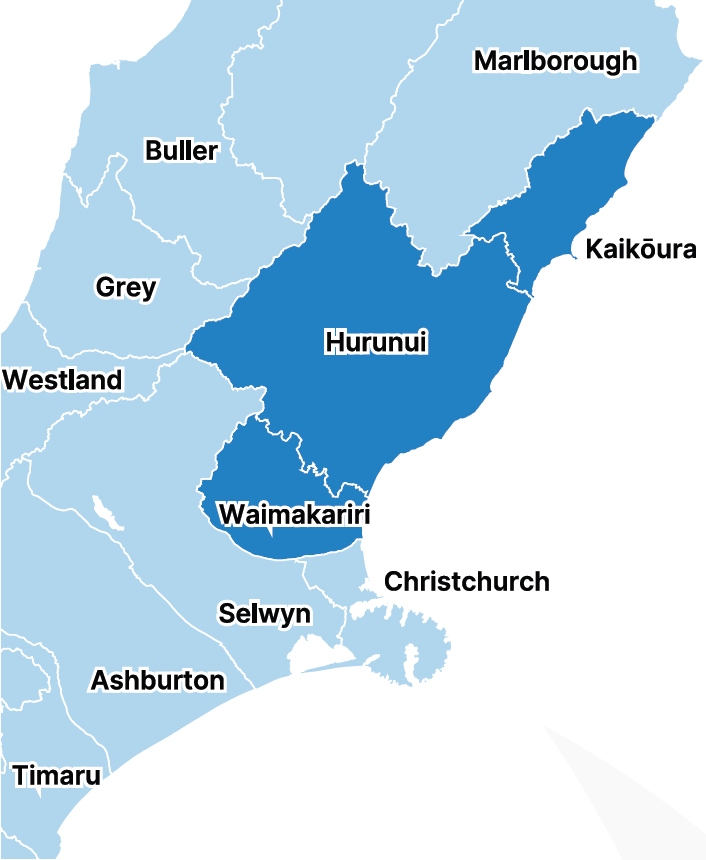
    Waimakariri would join with Hurunui and Kaikōura to form a single council for North Canterbury, taking on both local and regional council responsibilities.

    What works in its favour

    • Keeps decision-making closer to home

    Councillors would represent communities with similar rural, provincial and small-town interests, helping ensure decisions reflect local needs.

    • Maintains North Canterbury identity

    This option aligns with how many residents already see their community—connected across North Canterbury rather than centred on Christchurch.

    • Builds on existing collaboration

    Councils in North Canterbury already work together and share services such as engineering design, procurement and elements of water delivery. A unitary council


    Waimakariri would join with Hurunui and Kaikōura to form a single council for North Canterbury, taking on both local and regional council responsibilities.

    What works in its favour

    • Keeps decision-making closer to home

    Councillors would represent communities with similar rural, provincial and small-town interests, helping ensure decisions reflect local needs.

    • Maintains North Canterbury identity

    This option aligns with how many residents already see their community—connected across North Canterbury rather than centred on Christchurch.

    • Builds on existing collaboration

    Councils in North Canterbury already work together and share services such as engineering design, procurement and elements of water delivery. A unitary council would formalise this and build on what is already working well.

    • Better alignment of planning and service delivery

    Combining regional and local functions could make it easier to coordinate infrastructure, environmental management and growth planning across the area.

    • Stronger regional collaboration on shared services

    A North Canterbury unitary council could coordinate more closely with central agencies like NZ Transport Agency (NZTA) and national environmental regulators, while also expanding existing shared services (such as advocacy, emergency management and public transport) across the wider Canterbury area.

    • More control over priorities

    Investment decisions would be made within North Canterbury, rather than competing with the wider Christchurch metropolitan area.

    Challenges and risks

    • Smaller scale

    While larger than we are now, a North Canterbury council would still be relatively small compared to a metro model, which may limit some efficiencies or funding opportunities (if you consider bigger is better).

    • Balancing different communities

    Ensuring fairness across Waimakariri, Hurunui and Kaikōura—particularly between growth areas and smaller rural communities—would be important.

    • Proving the benefits

    Any proposal would need to clearly demonstrate it delivers better outcomes, not just a structural change.

  • (C) A Greater Christchurch Unitary Council

    Share (C) A Greater Christchurch Unitary Council on Facebook Share (C) A Greater Christchurch Unitary Council on Twitter Share (C) A Greater Christchurch Unitary Council on Linkedin Email (C) A Greater Christchurch Unitary Council link

    supporting image


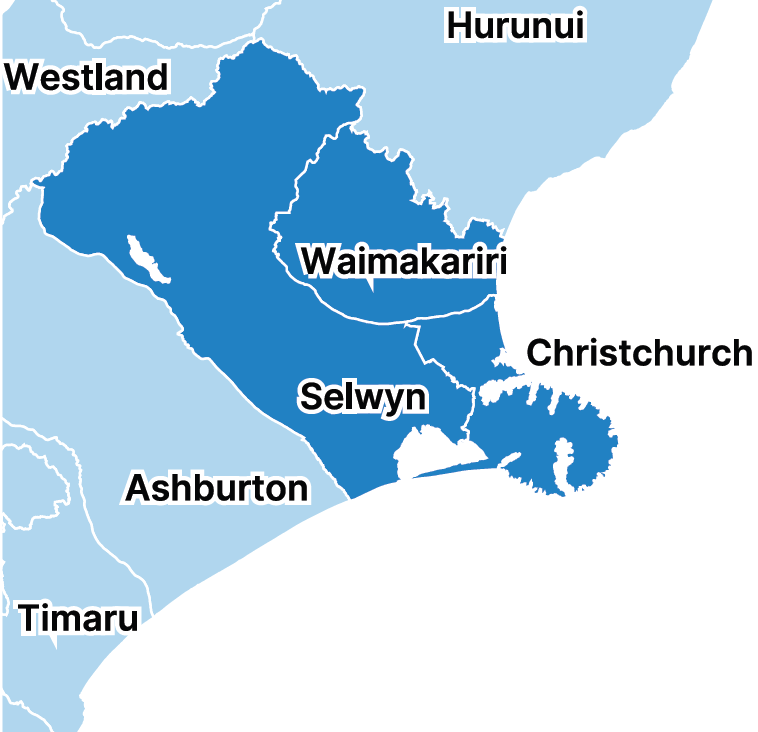
    Waimakariri would join with Christchurch and Selwyn as part of a larger, single metropolitan council.

    What this could offer
    • Stronger regional coordination

    Planning for growth, transport and infrastructure could be more integrated across the wider Christchurch area, reflecting how people already live and work across boundaries.

    • Greater scale and capacity

    A larger council could have more resources, expertise and borrowing capacity to deliver major infrastructure projects.

    • Potential efficiencies

    There may be opportunities to reduce duplication and streamline services across a larger organisation.

    • Better integration with national and regional systems

    A larger metropolitan council could align more directly with central agencies


    Waimakariri would join with Christchurch and Selwyn as part of a larger, single metropolitan council.

    What this could offer

    • Stronger regional coordination

    Planning for growth, transport and infrastructure could be more integrated across the wider Christchurch area, reflecting how people already live and work across boundaries.

    • Greater scale and capacity

    A larger council could have more resources, expertise and borrowing capacity to deliver major infrastructure projects.

    • Potential efficiencies

    There may be opportunities to reduce duplication and streamline services across a larger organisation.

    • Better integration with national and regional systems

    A larger metropolitan council could align more directly with central agencies such as NZTA and emergency management and deliver shared services like public transport and environmental monitoring at a larger scale.

    • Stronger influence nationally

    A single, larger council may have a stronger voice when working with central government.

    Challenges and risks

    • Reduced local voice

    Waimakariri would likely have fewer representatives in a much larger council, making it harder to ensure our communities’ needs are prioritised.

    • Rural and local priorities could be diluted

    Decisions may be driven by the needs of the larger Christchurch urban area, rather than smaller towns and rural communities. Reorganisation may only include the urban areas of the district.

    • Potential inefficiencies

    Arguably, a larger organisation could also result in a higher level of administration/bureaucracy which could reduce responsiveness.

    • Loss of identity

    There is a real risk that Waimakariri’s distinct character and community identity could be lost within a metropolitan structure.

    • Financial implications

    A combined council would bring together different financial positions. This raises questions about how debt, costs and investment priorities are shared across the wider area.

Page last updated: 05 Jun 2026, 01:26 PM